Cat “turned on” a heater, and chicks “pulled” a robot: unusual experiments that still provoke debate
In a cold shed, a cat settled near an electric lamp, trying to get warm. The lamp kept turning on and off—its operation was controlled by a random number generator. But the physicist observing the experiment noticed a peculiarity: when the cat was warming itself near the lamp, the lamp turned on slightly more often than probability theory would predict.
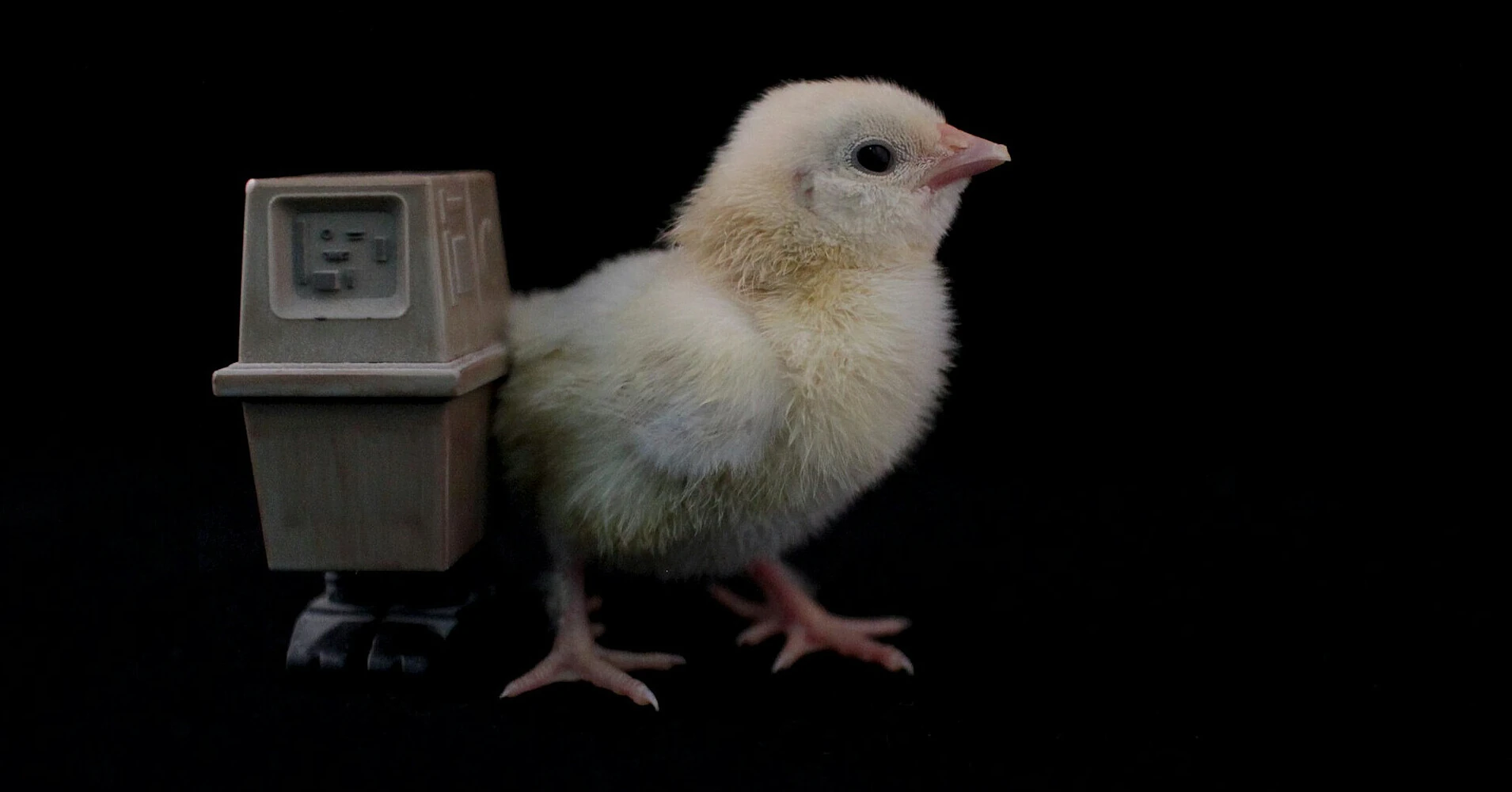
Years later, a French researcher conducted an equally remarkable experiment. Newborn chicks mistook a small robot for their mother, and its random movements seemed to bring it toward the chicks more often.
Both researchers published their results in specialized scientific journals. But they never managed to prove that the animals actually influenced the devices. What really happened in these unusual experiments?
The Cat That Wanted Warmth
In 1970, physicist Helmut Schmidt decided to test a strange hypothesis: can the need of a living being somehow influence random events?
For the experiment, he placed a year-old cat in a cold shed where the temperature remained around freezing. The only source of heat was a 200-watt electric lamp.
But there was one caveat: the lamp was not on constantly. Its switching on and off was controlled by an electronic random number generator.
Imagine someone flipping a coin every second. Heads—the lamp turns on, tails—it turns off. With a sufficiently large number of flips, both outcomes should occur with roughly equal frequency.
The cat quickly found the warm spot and settled near the lamp.
In the first five half-hour sessions, the generator issued 9,000 commands. By probability theory, about 4,500 of them should have turned on the heater.
However, the actual number of such commands was 4,615.
The difference is only 115 extra activations, or about 1.3 percentage points. But with that many events, the deviation seemed unusual enough to attract the researcher’s attention.
And then something even more curious happened.
After a few sessions, the cat stopped settling near the lamp. Perhaps it grew tired of the constantly flickering light.
At the same time, the unusual deviation disappeared: the number of activations returned to the expected distribution.
Schmidt suggested that the result might depend on how much the animal needed warmth.
But there remained a much simpler explanation: the first series might have accidentally been unusual, and the subsequent ones showed normal generator operation.
The results of the experiment were published in December 1970 in the Journal of Parapsychology.
Chicks That Mistook a Robot for Their Mother
In the 1980s, French researcher René Peoc’h decided to test a similar idea. But instead of a cat, he used newborn chicks, and instead of a heater, a small robot.
The experiment was based on a well-known biological phenomenon—imprinting.
Soon after hatching, chicks are able to bond with a moving object and follow it as if it were their mother. A real hen is not necessary.
Peoc’h introduced the chicks to a small autonomous robot called a tychoscope. The device moved around an arena, and the direction of each movement was determined by a random number generator.
Gradually, the chicks became accustomed to the robot and began to follow it.
Then each chick was placed in a transparent cage at the edge of the arena. The chick could see its mechanical “parent” but could not approach it.
Meanwhile, the robot continued to move according to random commands.
This is where the most interesting part of the experiment began.
According to the results presented by Peoc’h in his 1986 doctoral dissertation, in 78 out of 100 trials, the robot predominantly moved on the half of the arena near the chick’s cage.
When the cage was empty, no such pronounced predominance of movement to one side was observed.
It appeared that the robot, which was supposed to move randomly, ended up near the chick more often—a chick that sought to be close to its unusual “parent.”
Peoc’h continued his research and in 1988 published an article in the Journal of the Society for Psychical Research.
What Happened When the Robot Was Given a Candle
In 1995, the researcher decided to modify the experiment.
Now the chicks were not imprinted on the robot as their mother. Instead, a lit candle was mounted on the device, and the room was darkened.
The chicks found themselves in darkness. The only light source moved around the arena, with its direction again determined by a random number generator.
The results were similar to the previous ones.
In 57 out of 80 trials, the robot with the candle predominantly stayed on the side of the arena near the chicks—about 71% of the trials.
When the experiment was conducted without animals, the distribution was close to random. And in daylight, when the candle was unnecessary, no pronounced deviation was observed.
Peoc’h suggested that what matters is not merely the presence of animals, but their interest in a particular outcome.
In one case, the chicks sought the object they perceived as their mother. In the other, they sought the light source.
The work was published in the Journal of Scientific Exploration.
But an obvious question arises: if the results were so unusual, why did they not become a universally accepted scientific discovery?
Why Scientists Never Obtained Convincing Confirmation
The main problem with such experiments is that a statistically unusual result does not yet prove the existence of an unknown physical force.
Randomness sometimes creates sequences that seem incredible. For example, a coin can indeed land heads six times in a row. That is unusual, but it does not mean someone is mentally controlling the coin.
Moreover, the design of an experiment can sometimes influence statistics without the researcher noticing.
In Peoc’h’s experiments, the robot moved within a confined arena. When approaching a wall, it had to change direction, and this could affect the distribution of trajectories.
But why then was no similar deviation observed in trials with an empty cage?
There is no definitive answer. Perhaps the experimental and control conditions differed more than assumed. Flaws in statistical analysis are also possible.
Attempts to test related hypotheses have indeed been made.
In 2005, a research group led by Donald Bedford used a modified version of Peoc’h’s setup to test the purported influence of seven-day-old chicks on a robot’s random movements.
The result was negative: the researchers found no evidence of the claimed effect. They reported this in Chicks and Algae: The Remote Influence of Desire.
Because the setup differed from the original, this check could not definitively explain Peoc’h’s results, but it did not confirm them either.
There is still no reliable independent replication of the original experiments that convincingly demonstrates animals’ influence on random number generators.
More than half a century has passed since the cat experiment, and nearly forty years since Peoc’h’s first experiments.
The cat was cold, and the chicks wanted to be near their mechanical “parent” or light source. And the devices seemed to respond to these needs.
Perhaps the researchers encountered rare coincidences or features of their experimental setups that they could not fully account for. Or perhaps the story of these experiments will have a continuation.
For now, they remind us of an important feature of science: even the most astonishing results become discoveries only when they can be reliably reproduced.
Original sources: Helmut Schmidt, “PK Experiments with Animals as Subjects”, Journal of Parapsychology, 1970, 34, 255–261; René Peoc’h, “Chicken Imprinting and the Tychoscope: An ANPSI Experiment”, Journal of the Society for Psychical Research, 1988, 55, 1–9; René Peoc’h, “Psychokinetic Action of Young Chicks on the Path of an Illuminated Source”, Journal of Scientific Exploration, 1995, 9(2), 223–229; Donald Bedford et al., “Chicks and Algae: The Remote Influence of Desire”, 2005.